SC AC Install

Why your AC compressor won't kick on in South Carolina

Step 1 of 3: Equipment

Why won't my AC compressor turn on in South Carolina?

It's hot and the outside unit at your house just sits there. The fan inside might run, air might come out of the vents, but that low hum from the compressor outside never starts. In South Carolina summer heat, that's the part that worries people, because without the compressor the air coming out isn't actually cold.

Usually a bad capacitor, a tripped breaker, or a safety switch stopping it on purpose

The compressor needs a strong jolt of power to start, and a weak or failed capacitor can't deliver it. That's one of the more common reasons it stays quiet. A tripped breaker or a blown fuse at the outdoor disconnect will do the same thing. Sometimes the compressor isn't broken at all, it's being stopped by a safety control because the refrigerant pressure is too high or too low, or because airflow across the indoor coil is restricted. With South Carolina summers running hot and humid for months, outdoor units work hard and run long hours, and that extra strain is what tends to catch a weak capacitor or a clogged coil at the worst time.

  1. Thermostat calls for cooling and sends power to the contactor.

  2. The contactor's coil pulls the switch closed to energize the compressor.

  3. Capacitor sends the compressor motor a jolt to start spinning.

  4. Compressor should hum and start pumping refrigerant through the outside unit.

Why does your house feel warmer every afternoon?

Air still comes out of the vents, but it's not cold anymore, just room temperature or close to it. The thermostat says 72 but the house reads 80. Outside, the unit sits quiet. No hum, no vibration, nothing. You might notice the fan blade isn't spinning either, or it's spinning slow. Left alone through a South Carolina summer, a house with no real cooling climbs fast, and that matters if anyone inside is older, very young, or has a health condition that doesn't do well with heat. It also means the system is running the indoor fan for nothing, using power without cooling a single room.

An outdoor air conditioning condenser unit on a concrete pad beside a house with white horizontal lap siding, with an electrical disconnect box and insulated refrigerant line on the wall and a shrub over mulch to the right.

The compressor is doing its job

The condenser sits on its pad against the house, lines running clean to the disconnect box. A hum comes from inside the unit, steady and low. Air from the vents feels cold against your hand, and the house holds the temperature the thermostat is set to.

An outdoor air conditioner condenser unit on a concrete pad beside a house with light horizontal lap siding, with an electrical disconnect box and conduit on the wall behind it.

The compressor is staying quiet

The unit outside shows its age, the casing weathered, the disconnect box mounted on the wall beside it same as always. But nothing hums. No vibration through the pad, no sound from inside the cabinet. The fan up top may spin on its own, the compressor underneath stays off.

A smiling man in a navy long-sleeve shirt sits at a wooden table in a kitchen and dining area, with a ceramic mug, a potted plant, and a sliding glass door behind him.
A smiling bearded man in a green henley shirt stands at a kitchen island with a gray mug, looking off to the side, with a dining area and shelves blurred behind him.
A smiling bearded man in a navy sweater sits at a white kitchen island with a ceramic mug, with open shelves, potted plants and a range hood behind him.
A smiling man in a dark olive long-sleeve shirt sits in a kitchen beside a counter with a dark mug, with a dining table, sideboard and hallway visible in the blurred background.

A capacitor that's failing doesn't always quit all at once. It can push the compressor some mornings and not at all by afternoon, once the South Carolina heat has had hours to work on it.

That's why a compressor can run fine one day and sit silent the next, same house, same thermostat setting, nothing you did different.

A man in a blue T-shirt sits on a light gray sofa, laughing while looking at an open laptop in the foreground, with a framed picture, lamp and potted plant behind him.
A bearded man in a blue and brown plaid flannel shirt stands indoors looking out a window at snow-covered trees, with a ceramic mug on the windowsill.

You call someone every time

The unit goes quiet and you're on the phone that afternoon, before the house has a chance to climb past 80. Nobody argues with you about whether it's worth a visit. A contractor comes out, checks the capacitor, the contactor, the pressures, and either fixes it on the spot or tells you what part is failing before it quits for good. The compressor gets replaced, maybe, but the condenser coil and the rest of the system keep running another ten years instead of getting dragged down with it.

You wait and see if it clears up

The fan still runs, air still moves, so it's easy to tell yourself the heat is just worse than usual this week. Days pass. The compressor that cycled out this afternoon manages to limp through tomorrow morning, then stops answering the thermostat at all. By the time someone looks at it, a bad capacitor has taken the compressor with it, and a service call has turned into a replacement, in the middle of a South Carolina summer with the house sitting at 85.

Power costs 15.12 cents per kilowatt-hour statewide

At 15.12 cents a kilowatt-hour, a compressor that short-cycles or struggles to start pulls harder than one running clean, and that shows up on your bill before you ever see it hum again. Catching the capacitor or contactor now costs less than letting the unit fight through another week of South Carolina heat.

EIA-861 2025 statewide residential average

A gray outdoor air conditioner condenser unit on a concrete pad beside a house with white horizontal siding and a brick foundation, with a wall-mounted disconnect box and conduit, and a green shrub with mulch at left.

Unit running clean

The condenser sits on its pad, lines running up to the disconnect box, and nothing on it looks like it needs attention. Dirt hasn't built up on the grille or the coil underneath it. Air moving through a clean unit like this has an easier path, and the compressor inside isn't working against anything extra to do its job.

An outdoor air conditioning condenser unit on a concrete pad beside a house with white horizontal vinyl siding, with a gray electrical disconnect box and refrigerant lines on the wall behind it.

Unit caked with grime

The same kind of unit, but the wire grille and top cover are gray with dirt and grass clippings. That buildup blocks the airflow the unit needs to shed heat, and a compressor running behind a dirty coil works harder in South Carolina's heat than it should have to. Left alone, that extra strain is often what finally keeps it from starting at all.

An outdoor air conditioning condenser unit on a concrete pad beside a house with horizontal lap siding, with an electrical disconnect box and conduit on the wall, mulch and a green shrub to the right, and a concrete walkway in the foreground.
Before you get your air conditioner repair
A gray outdoor air conditioner condenser unit on a concrete pad beside a house with horizontal siding and a stucco foundation, with a disconnect box and conduit on the wall, decorative gravel, mulch, and a shrub nearby.
After you get your air conditioner repair
A single-story red brick building with a hipped shingle roof and several white-framed windows, fronted by a large empty asphalt lot with sun flare, surrounded by green trees under a bright hazy sky.

That heavy, hard-to-breathe feeling in a South Carolina summer comes from the dew point, which averages 69°F across June, July and August according to NOAA climate data. Air that thick holds a lot of moisture, and your air conditioner has to pull that moisture out before the house ever feels cool. That's extra work on top of just lowering the temperature. A compressor that's already weak from a failing capacitor or a worn contactor has to push harder through those months, and a part that might limp along in a drier climate gives out here instead. If yours has gone quiet, the moisture in the air is part of why.

NASA POWER T2MDEW county cells weighted by homes

Finding a pro stops being your job

A quiet compressor on a July afternoon in South Carolina is not something to sit with for days while you figure out who to call. You could start dialing around, explain the thermostat reading and the silent unit outside to one company, then do it again for the next, waiting on callbacks and comparing what each one quotes before you even know what's wrong. That's hours gone, and the house keeps climbing past 80 the whole time. A bad capacitor or a stuck contactor doesn't get better on its own, and every afternoon it sits unfixed is another afternoon the compressor strains to catch up once it does kick on. Sending the request here means you're done hunting. You stop being the one who has to find, vet, and chase down a contractor, and that part of it is simply off your plate. Someone still has to look at the unit and fix what's wrong with it, but finding them stops being your problem the moment you send this.

What's Actually Stopping the Compressor

  • A run capacitor stores the charge that gives the compressor motor its first push to start spinning.
  • If that charge is weak, the compressor may hum once, try to start, and then trip off on its own protection.
  • The contactor has to pull in fully or the compressor gets partial power and never starts at all.
  • A dirty condenser coil outside makes the compressor work against more pressure, which strains the start-up even if the capacitor is fine.
  • Most outdoor units carry a high-pressure or low-pressure switch that shuts the compressor off before the motor can be damaged.
  • A compressor that's overheated from running hard in the afternoon sun may have an internal overload that keeps it from restarting until it cools.

The compressor needs a jolt to get its motor spinning, and the run capacitor is what holds that charge. When a capacitor weakens, it can still deliver enough for the compressor to hum and lean into starting, but not enough to finish the job. The motor's own protection senses it's drawing too hard without turning over, and shuts it down before anything burns out. That's why you might hear one attempt, then silence.

The contactor plays a part too. Its job is to pull in fully and send full power to the compressor. If the contacts are pitted or the coil is weak, the compressor gets partial power, which isn't enough to start it at all.

Even a good capacitor and a good contactor can't overcome a condenser coil caked with a summer's worth of dirt and grass clippings. That buildup raises the pressure the compressor has to push against right as it's trying to start, which is exactly the moment it has the least power to spare.

Most outdoor units also carry a high or low-pressure switch built in as a safeguard, cutting the compressor off before pressure gets high enough to damage the motor. And after hours of running hard in the afternoon sun, an overheated compressor can trip its internal overload, which keeps it locked out until the motor cools back down, sometimes a while after the temperature outside has already dropped.

A gray outdoor air conditioner condenser unit on a concrete pad beside a house with horizontal lap siding, with a flowering shrub at left and a disconnect box with conduit on the wall at right.
The condenser sits clean on its pad, conduit running down to the disconnect, nothing blocking the airflow around it.
An outdoor air conditioner condenser unit on a concrete pad beside a house with light horizontal vinyl siding, surrounded by bare dirt, gravel and dry leaves, with refrigerant lines and conduit running along the wall.
Leaves and dirt have built up around the base, and refrigerant lines run along a wall that's seen a lot of South Carolina summers.
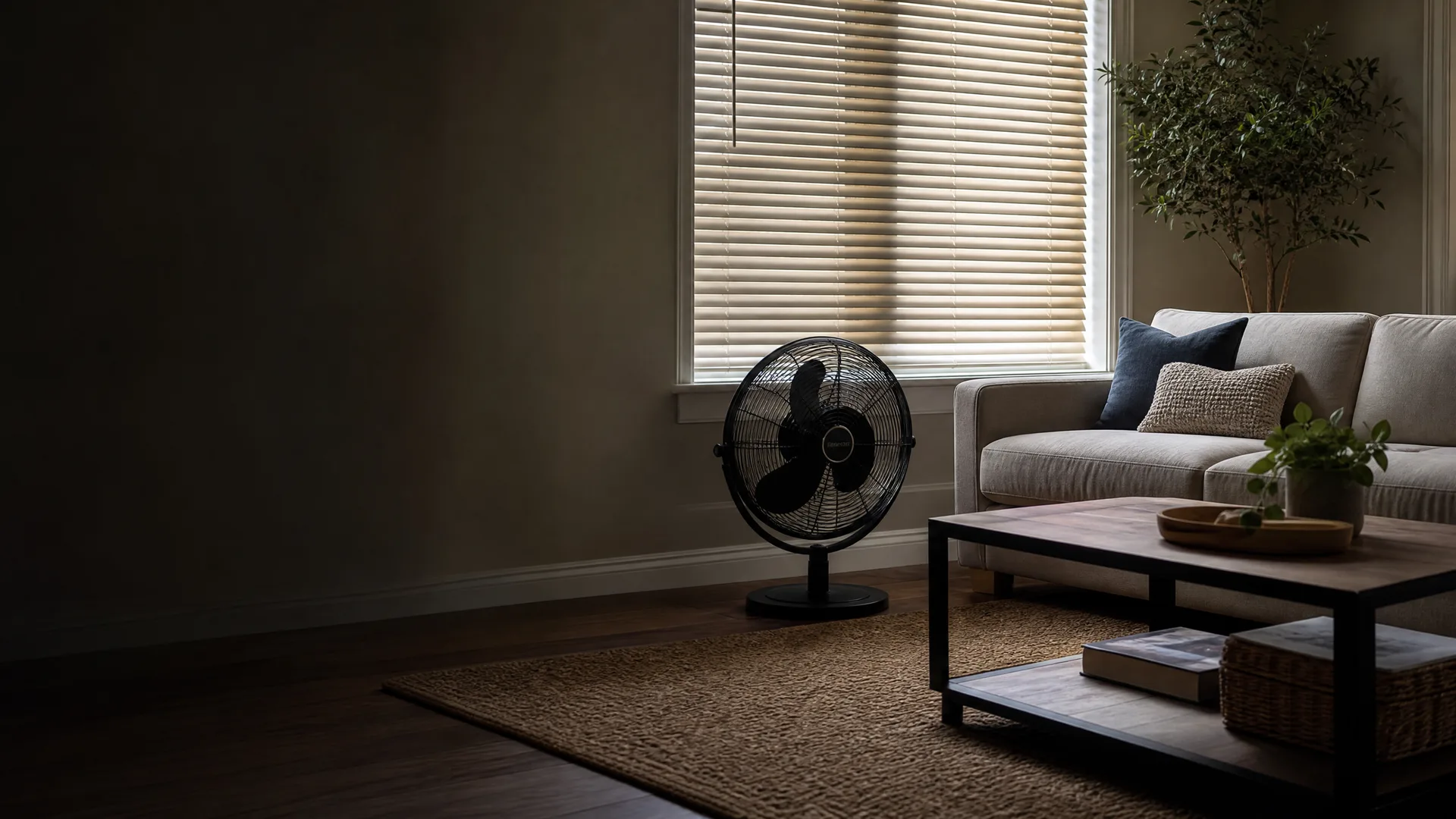
A dimly lit living room with a black table fan on the wood floor near a window with closed blinds, beside a light-colored sofa with cushions, a wooden coffee table, a woven rug, and a potted tree.

The blinds stay shut against the sun, and the living room sits in that dim, grayish light you get when you're trying to keep the heat out. A floor fan runs next to the couch, turning its head back and forth, pushing the same warm air around. It's past two in the afternoon and the house has that stale feel to it, like the air's been breathed already. You catch yourself checking the thermostat again, same as you did twenty minutes ago, like it might read different this time. Outside the window the unit sits against the house, still and quiet. You can hear the fan blades ticking next to you, and under that, nothing. No hum from the yard at all.


A compressor that won't kick on almost always traces back to the same few parts. The thermostat calls, the contactor has to pull in, the capacitor has to give the motor its first push. When one of those fails, the unit sits quiet no matter how high the heat climbs outside. That's the answer. What you do with it is the only thing left to decide. You could spend the afternoon calling around, telling one company about the thermostat reading and the silent unit outside, then telling the next one the same thing while you compare what each one quotes you. Or you could send one form and let that searching become someone else's job instead of yours. Either way the compressor still needs a licensed hand on the capacitor, the contactor, or whatever else is keeping it from starting. The house doesn't cool itself in the meantime, and the heat doesn't wait for you to finish comparing estimates. Getting it in front of a contractor is the whole point from here.

A gray standing-seam metal roof with two stone chimneys in the foreground, framed by pine branches and moss-draped trees, overlooking misty forested hills and distant mountains under an overcast sky.

Let someone else find the pro

Hand off my repair

Sending the form costs nothing.

A silent compressor doesn't fix itself by waiting. Send the request and someone with the right tools takes it from here, so you're not stuck checking the outside unit every hour hoping it kicks on while the house climbs past 80.