SC AC Install
Profile view of a bearded man wearing a dark green baseball cap and a dark gray T-shirt against a plain light background.

How to get your AC ready for a South Carolina summer

Step 1 of 3: Equipment

When should I get my AC serviced before summer in South Carolina?

South Carolina summers get hot and muggy early, and your AC runs hard for months once they settle in. Getting the service done before that stretch starts means a technician can catch a weak capacitor, a dirty coil, or a low refrigerant charge before it leaves you waiting on a repair in July heat. The question is timing it right.

Schedule it in March or early April, before the heat and humidity set in

March and early April give a technician time to check your system before it has to run all day against South Carolina heat and humidity. Refrigerant levels, electrical connections, and the condenser coil all get checked while the unit is still working under easy conditions, not straining through a 95 degree afternoon. Schedule it later, once the heat has already arrived, and any problem found becomes a problem you are living with while you wait for a repair slot, because that is also when every other AC in the area starts acting up. Getting ahead of it in spring means small issues get caught and fixed before they turn into a system that quits in August.

A man in a blue sweatshirt reclines with closed eyes in a brown leather armchair in a living room with a bookshelf, houseplant, sofa, window, and a side table holding newspapers and a dark mug.
A bearded man in a gray pullover reclines with closed eyes on a brown leather sofa in a sunlit room with a window, framed picture, potted plant, and a wooden cabinet holding papers and a dark mug.
A man in a gray sweater leans back with closed eyes in a brown leather armchair beside a wooden side table holding a dark mug and a folded newspaper, with bookshelves and a window seat behind him.
A man in a green sweater reclines in an armchair with his eyes closed and a slight smile, beside a window with plants, a small table holding a mug and folded newspaper, and bookshelves behind him.

Why does your AC feel like it's struggling already?

You turn it on for the first warm week and it runs long stretches without the house feeling any cooler. The air out of the vents feels weaker than it should. Maybe you hear a rattle on startup, or notice the unit outside icing over, or the indoor air feels damp even with the AC running. These are signs something's already working harder than it needs to, usually a dirty coil, low refrigerant, or a clogged filter choking airflow. Left alone through a South Carolina summer, that strain tends to end in a system that quits entirely on the hottest day, or a utility bill that climbs steadily without anyone touching the thermostat.

An outdoor air conditioner condenser unit beside a house with horizontal siding and stucco, its coil fins covered in white cottonwood fluff that also collects on the surrounding grass and mulch.

You're out pulling weeds along the side yard in late April, and you walk past the condenser on your way to the hose spigot. Something pale is caught in the fins, drifted up against the whole side of the unit like a thin layer of snow that didn't melt. It's cottonwood fluff, and it's packed in tight enough that you can't see the metal underneath anymore. You crouch down and touch it, and it doesn't just brush away. You think about how hard that unit has to pull air through to cool your house once the heat sets in, and whether it's been fighting through this all week without you knowing.


Service Now or Wait It Out

Service it now

  • A technician checks refrigerant charge while the unit is still running cool, so a low charge gets found before it has to fight 95 degree heat.
  • Coils get cleaned while pollen and whatever blew in over winter is loose, not baked on from a month of hard running.
  • A weak capacitor or a failing contactor gets caught on a bench test, not during a Saturday afternoon when the house is already 82 inside.
  • Scheduling is easier in spring, before every AC in the state needs a tech at once.
  • You get the whole summer, April through October, running on a system that's been checked rather than one you're hoping holds.

Wait and see

  • The unit keeps running on whatever charge and wiring it has now, good or not, until something forces the issue.
  • A small problem, a weak capacitor or a dirty coil, keeps costing you efficiency every day it runs, even before it fails outright.
  • If it breaks in July, you're calling around for a tech during the week every other AC in South Carolina is calling too.
  • A breakdown in the heat means days of searching and comparing instead of a scheduled visit on your own timeline.
  • You find out what's wrong only once the house stops cooling, not before.
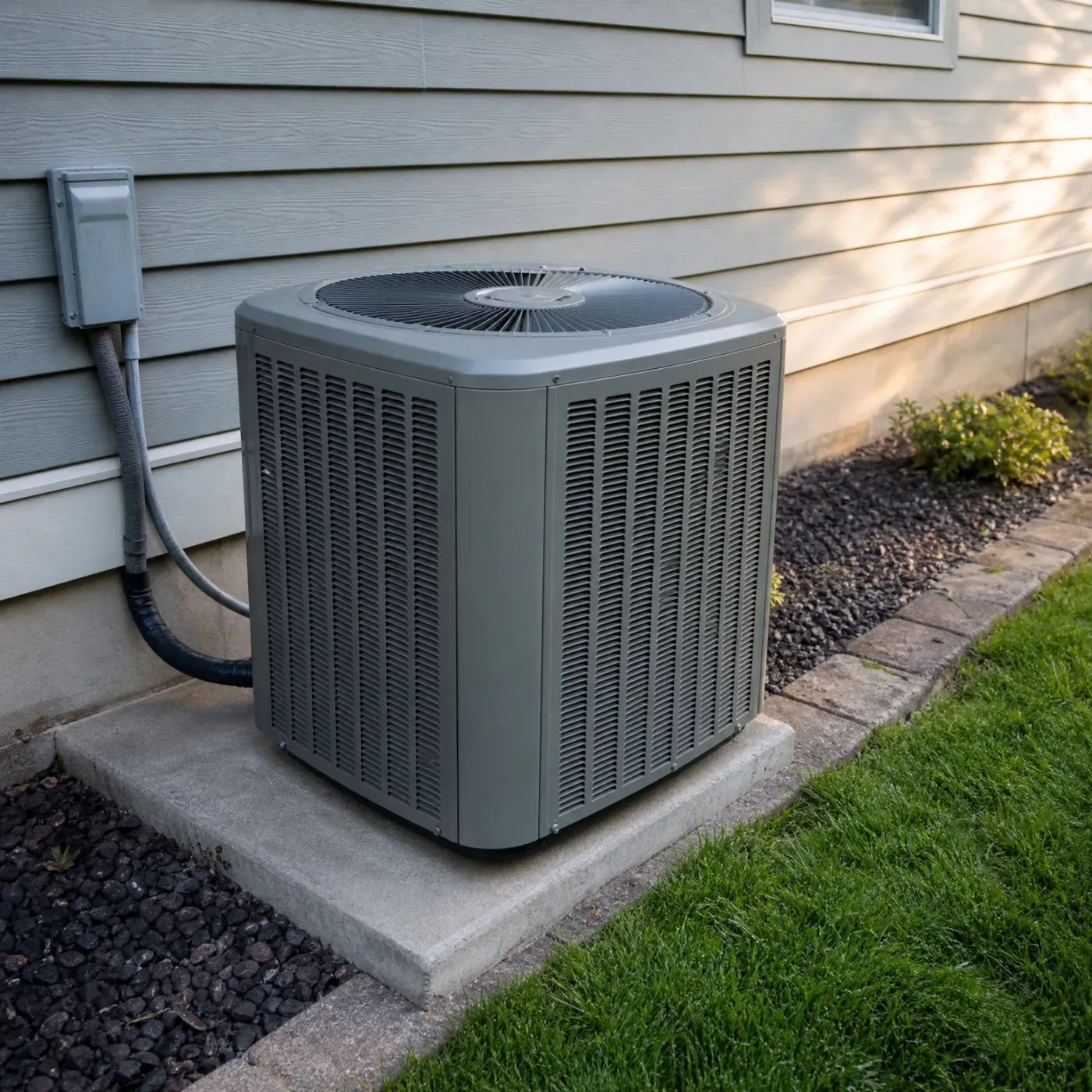
A gray outdoor air conditioning condenser unit on a concrete pad beside a house with horizontal lap siding, with a wall-mounted electrical disconnect box and refrigerant lines, shrubs, mulch and lawn around it.

Running the way it should

This is a condenser that got looked at before the heat set in. The fins are clean, the pad is clear, and the disconnect box is easy to reach if a technician needs to shut it off. Nothing here is working harder than it has to.

An outdoor air conditioner condenser unit on a concrete pad beside a house wall with stucco lower section, horizontal siding above, and a white downspout to the right.

Running on borrowed time

Dirt and grime cover the fins on this one, thick enough to block airflow through the coil. The unit still runs, but it has to pull harder to move the same amount of heat out of the house. That strain adds up over a South Carolina summer.

A closed silver laptop and a glazed ceramic mug on a wooden table, with a blurred kitchen counter, potted plant, cutting board and window in the background.

What a technician actually checks

A tune-up isn't just a glance at the unit. A technician measures the refrigerant charge with gauges, checks the pressures against what that system is supposed to run, and tests the capacitor that gets the compressor and fan motor started. Low capacitance there is one of the most common reasons an AC won't start on a hot afternoon. They'll also check the contactor, the relay that switches power to the outdoor unit, since a pitted one can fail without warning.

Inside, the evaporator coil gets checked for dirt and airflow across it, and the condensate drain gets cleared so it doesn't back up into the pan once humidity picks up. None of this is guesswork, and none of it is something to sort out over the phone with five different companies. Send one form, and you're done hunting down a contractor, explaining the same symptoms over and over, and weighing quotes against each other. Someone qualified takes it from there.

A living room corner with a beige sofa and cushion, a round wooden coffee table holding a pale ceramic vase of eucalyptus stems and a wooden bowl, and a curtained window with a potted plant above a latticed radiator cover in the background.
A gray outdoor air conditioning condenser unit on a composite pad beside a house with horizontal lap siding, with a wall-mounted disconnect box, refrigerant lines, and a wooden fence and shrubs to the left.

Working the way it should

This condenser is doing what it's built to do. The disconnect box is clear, the lines run clean up the wall, and nothing around the pad is blocking airflow. A unit left alone to run like this all summer is the one that makes it to October without a breakdown call.

An outdoor air conditioning condenser unit on a concrete pad beside a house with light vinyl siding, with electrical conduit running to a wall-mounted disconnect box and a shrub in mulch to the right.

Heading for a breakdown

Same setup, same wall, but this is the unit nobody's checked on. Wiring and conduit still connect it, but a dirty coil or a weak capacitor doesn't show from the yard. By the time it quits in July, whatever's wrong has been building since spring.

A gray-haired man with a beard in a blue button-placket shirt reclines on a couch with his eyes closed, beside a sunlit window with a green plant.
A woman in a cream knit sweater sits in an armchair with her eyes closed near a window showing yellow autumn foliage, with a mug on a round wooden side table beside her.

Stop chasing an air conditioner pro

You already know what's coming. Once it's hot and staying hot, that AC runs from morning to night and doesn't get a real break until fall. If something's been off since last summer, a weak capacitor, a low charge, a coil that needs cleaning, this is the stretch where it shows up, usually on the afternoon you need the house cool the most. Finding someone to look at it before then means calling around to companies you don't know, waiting to hear back, explaining the same thing more than once, then weighing quotes against each other with no good way to tell who's right. Send the request here and that part is off your plate. You're not left searching on a hot afternoon with the house already warm, or waiting on a callback from a number you found online. A technician gets to your unit, looks at what's actually going on with it, and you've got that settled before the heat really sets in.

A single-story red brick ranch house with a white door, white-trimmed windows and a shingled hip roof, fronted by a wide asphalt driveway with sunlight glare, surrounded by green deciduous trees under a pale sky.

A summer dew point averaging 69°F across South Carolina is the figure that tells you why the air feels thick even on a day that isn't that hot, according to NOAA climate data. Your AC isn't just lowering the temperature, it's pulling that moisture out of the air, and the wetter the air coming in, the longer the unit has to run to do it. At 69°F, that's most of the work your system does from June through August. You'll notice it in a house that feels damp even with the thermostat set low, or a unit that never seems to shut off in the afternoon. That's the moisture, not just the heat.

NASA POWER T2MDEW county cells weighted by homes

An outdoor air conditioning condenser unit sits on a concrete pad beside a house with horizontal vinyl siding, with a gray electrical disconnect box and insulated refrigerant line on the wall above, surrounded by bare mulched ground.
Before you get your air conditioner maintenance
A gray outdoor air conditioning condenser unit sits on a concrete pad beside a house with horizontal siding, connected by insulated lines to a wall-mounted disconnect box, with a shrub and gravel bed to the right.
After you get your air conditioner maintenance

What a dirty coil costs you

The outdoor coil gives up heat to the air outside, and it can only do that if air moves through it freely. Once pollen and grass clippings cake onto the fins, the unit can't shed heat the way it's supposed to, so the compressor runs longer to get the same cooling. It also runs hotter than it was built to run. A technician can rinse the fins clean during a tune-up, before the heat sets in and before that coating has months to bake on. That's a five minute fix in April and a harder one in August, when the unit hasn't had a break long enough to let anyone near it.

Why the capacitor matters most

The capacitor stores the jolt of electricity that gets the compressor and fan motor started every time the thermostat calls for cooling. It weakens slowly, long before it fails outright, and a weakening capacitor makes the compressor strain on every single startup. In South Carolina, where that startup happens dozens of times a day for months, a capacitor that's already borderline in April usually doesn't make it to September. Testing it while the unit is barely running, rather than waiting for a hot stretch to find out the hard way, is the difference between a small part swapped on a mild day and a no-cool call during a heat wave.

Power costs 15.12 cents per kilowatt-hour statewide

At 15.12 cents a kilowatt-hour, power here isn't expensive compared to a lot of the country, but an AC that's low on charge or fighting a dirty coil still draws more to do the same job. A tune-up before summer keeps that draw where it should be instead of climbing all summer long.

EIA-861 2025 statewide residential average

Get your AC looked at before South Carolina's heat sets in, while the technician can still catch a weak capacitor or a low charge without the pressure of a 95 degree day behind it. That's the whole answer. The part that's harder is finding someone to do it: searching around, calling a few companies, explaining the same thing about the rattle or the weak airflow each time, then sitting with quotes trying to figure out who's worth the call. Once you send this one form, that part is off your plate. You're not the one tracking down a contractor anymore. Your AC still has to run all summer, through the muggy stretch where it barely shuts off, and no visit changes that. What changes is whether it's running clean or running tired when that stretch hits. You already know which one costs you less grief in July.

A gray outdoor air conditioning condenser unit on a concrete pad beside a house with horizontal lap siding, with a wall-mounted disconnect box and conduit, lava rock mulch, a shrub, and grass nearby.

Send one request and you're done looking

Hand off the search

Fill out one short form instead of calling around.

You only hire the pro if you want to.